

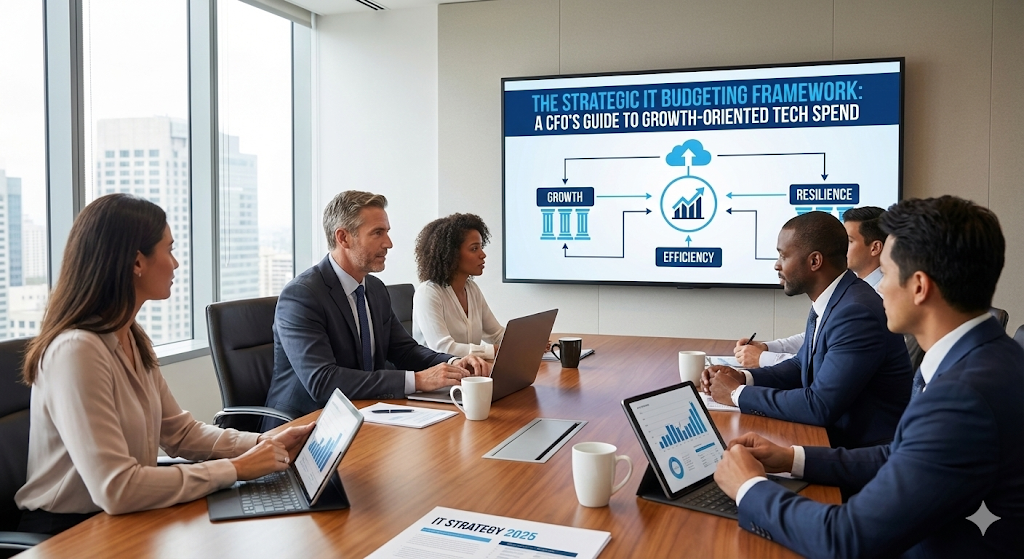
The annual IT budget meeting is a moment most leaders dread. For the IT team, it’s a battle to justify every line item. For the finance team, it’s a frustrating exercise in trying to rein in what feels like a black box of ever-increasing costs.
You know the feeling. You present a budget filled with necessary upgrades, licenses, and security tools, only to be met with skeptical looks and the inevitable question: “Why do we need to spend this much on IT?”
The problem is, for decades, most businesses have treated technology as a cost center—a necessary evil you pay for to keep the lights on. But in today’s world, that mindset isn’t just outdated; it’s a direct threat to your growth. Your technology stack isn’t just an expense line. It’s the engine that powers your sales, streamlines your operations, protects your reputation, and ultimately drives your competitive advantage.
This guide is designed to change that conversation. We’re going to give you a practical, defensible framework for building an IT budget that doesn’t just ask for money, but tells a compelling story about growth, efficiency, and resilience. This is how you transform IT from a budget line to be minimized into a strategic investment to be maximized.
Table of Contents
- Part 1: The Mindset Shift: From Cost Center to Growth Engine
- Part 2: The Two Core Budget Buckets for Scaling Businesses
- Part 3: Choosing Your Budgeting DNA: ZBB vs. VBB for IT
- Part 4: Future-Proofing Your Forecast: Agility and Resilience
- Part 5: The CIO’s Guide to Budget Justification (The ROI Formula)
- Part 6: Continuous Optimization: Mastering FinOps & Cloud Waste
- Frequently Asked Questions
Part 1: The Mindset Shift: From Cost Center to Growth Engine
Before we talk numbers, we have to talk philosophy. The single most important shift is viewing your IT budget not as a percentage of cost, but as a percentage of revenue. It’s an investment in the infrastructure that generates that revenue.
So, what’s the right number?
While every business is unique, industry data provides a powerful benchmark. A landmark study by Microsoft and the SMB Group found that growing small and medium-sized businesses typically invest 6–10% of their annual revenue in technology. And the fastest-growing companies? They often push that number even higher.
If your current IT spend is hovering around 2-3%, that’s not a sign of efficiency. It’s a red flag. It signals you’re likely accumulating “technical debt”—outdated hardware, unsecured systems, and inefficient workflows that are silently eroding your productivity and exposing you to risk. You’re going to pay for it eventually, the only question is when. And paying for it during a crisis is always more expensive.
Framing the discussion around this 6-10% benchmark immediately changes the tone. It’s no longer an arbitrary number pulled from the IT department’s wish list; it’s an industry-standard investment level required to compete and grow.
Part 2: The Two Core Budget Buckets for Scaling Businesses
Okay, so you’ve established IT as a strategic investment. Now, where does the money actually go? To make your budget clear and defensible, stop thinking in terms of a monolithic “IT budget.” Instead, divide every single expense into two distinct, purpose-driven buckets.
Bucket #1: Operational Spend (Keeping the Lights On)
This is the foundational, non-negotiable spending required to keep your business running securely and efficiently day-to-day. Think of this as the cost of doing business in a digital world. It’s predictable, recurring, and often falls under the Operating Expense (OpEx) model.
What goes in this bucket:
- Core Infrastructure: Internet connectivity, network hardware maintenance, server hosting.
- Software & Subscriptions: Microsoft 365 licenses, accounting software, CRM subscriptions, collaboration tools.
- Support & Maintenance: The cost of your internal IT staff or your managed IT services partner.
- Baseline Security: Antivirus, firewalls, spam filtering, basic data backup.
- Lifecycle Replacements: The planned, predictable replacement of aging laptops, servers, and network switches.
Bucket #2: Strategic Spend (Driving the Business Forward)
This is where the magic happens. Strategic spending is about funding specific projects and initiatives that directly support your larger business goals—like increasing revenue, improving customer experience, or entering new markets. These are often one-time projects that fall under the Capital Expense (CapEx) model, though many modern initiatives (like SaaS platforms) are OpEx.
What goes in this bucket:
- Growth Projects: A new e-commerce platform to boost online sales, a CRM implementation to improve lead tracking, or a business intelligence dashboard for better decision-making.
- Efficiency Projects: Automating a manual invoicing process to reduce administrative overhead, or deploying a new communication system to connect a hybrid workforce.
- Risk Mitigation: Advanced cybersecurity services like Endpoint Detection and Response (EDR), implementing a robust disaster recovery plan, or investing in compliance audits.
- Innovation & R&D: Experimenting with new technologies like AI-powered customer service bots or IoT sensors in a manufacturing plant.
Separating your budget this way makes it instantly understandable to non-technical stakeholders. They can clearly see the difference between “what we have to spend to operate” and “what we’re choosing to invest to grow.”
Part 3: Choosing Your Budgeting DNA: ZBB vs. VBB for IT
The “incremental” budget—taking last year’s number and adding 5%—is the enemy of strategic growth. It encourages waste and discourages innovation. To build a truly forward-looking budget, you need a more rigorous methodology. Two powerful approaches stand out for modern IT departments: Zero-Based Budgeting (ZBB) and Value-Based Budgeting (VBB).
Zero-Based Budgeting (ZBB): The “Why?” Approach
ZBB forces you to justify every single dollar from scratch, every single year. Nothing is carried over. For each requested expense, you have to answer: “Why is this necessary for the business?”
- Pros: It’s incredibly effective at cutting waste. You’ll uncover redundant software licenses, underutilized cloud resources, and “legacy” systems that no one uses but everyone is afraid to turn off. It’s perfect for a company that needs a hard reset on its IT spending.
- Cons: It can be time-consuming and can sometimes stifle long-term, innovative thinking in favor of short-term operational necessities.
- Best For: A business that feels its IT costs have spiraled out of control and needs to re-establish a baseline of essential spending.
Value-Based Budgeting (VBB): The “What If?” Approach
VBB flips the script. Instead of starting from zero, it starts with the company’s strategic goals and asks: “What technology investments will provide the most value in helping us achieve these goals?” Projects are funded and prioritized based on their potential ROI, risk reduction, or strategic impact.
- Pros: It directly aligns IT spending with business outcomes. It encourages innovation and positions the IT department as a strategic partner, not just a service provider.
- Cons: It requires a deep understanding of the business’s goals and can be more difficult to quantify than the hard costs of ZBB.
- Best For: A growth-oriented business that wants to use technology as a competitive weapon.
The Hybrid Solution
For most growing businesses, the best approach is a hybrid. Use ZBB for your Operational Spend bucket to ensure you’re running a lean, efficient operation. Then, apply VBB to your Strategic Spend bucket to make sure every investment is laser-focused on driving meaningful growth.
Part 4: Future-Proofing Your Forecast: Agility and Resilience
A budget isn’t a static document you create in Q4 and forget about. It’s a living plan that needs to adapt to unexpected challenges and opportunities. The two keys to building a resilient budget are an agile forecasting method and a dedicated contingency fund.
Adopt Driver-Based Forecasting
Instead of just guessing, Driver-Based Forecasting links your IT costs directly to tangible business metrics. Think about it this way:
- Instead of “IT budget for new hires,” you calculate the cost per employee (laptop + software licenses + onboarding support). Now, when the CEO says you’re hiring 20 new people, your budget adjustment is instant and justified.
- Instead of a generic “cloud storage” line item, you calculate the data cost per new client. As your sales team brings in new business, the need for more cloud spending is already baked into the model.
This method makes your budget dynamic and responsive. It also makes it much easier to explain to your finance team, because you’re speaking their language—the language of business drivers.
Build a Defensible Contingency Reserve
You know that moment when a critical server fails unexpectedly, or a new cybersecurity threat emerges that requires an immediate, unplanned investment? This is what sinks most IT budgets.
Trying to predict the unpredictable is impossible. But preparing for it is essential.
Best practices from finance and project management experts recommend establishing a contingency reserve of 5–15% of your total IT budget. This isn’t a slush fund. It’s a dedicated, pre-approved reserve for true emergencies: critical hardware failure, zero-day vulnerability patches, or sudden compliance requirements.
Having this line item in your budget from day one demonstrates foresight. It shows leadership that you understand risk and have a mature plan to handle it, preventing the need for frantic, off-cycle budget requests. Some forward-thinking organizations are even starting to use Generative AI tools to model potential scenarios and refine their forecasts, with some models achieving up to 95% accuracy in predicting cash flow needs.
Part 5: The CIO’s Guide to Budget Justification (The ROI Formula)
You’ve done the work. You have a data-backed, well-structured, and resilient budget. Now comes the most critical step: selling it to the C-suite.
Stop presenting a list of technologies. Start presenting a portfolio of business cases. For every major strategic initiative, frame it using a simple four-part formula:
1. The Problem/Opportunity
Clearly state the business problem you’re solving or the opportunity you’re seizing. Use numbers.
- Bad: “We need to upgrade our server.”
- Good: “Our current order processing server slows down by 30% during peak hours, leading to an estimated 5% cart abandonment rate and $75,000 in lost revenue last quarter.”
2. The Proposed Solution
Briefly describe the technology, but focus on the outcome.
- Bad: “We will purchase a new Dell PowerEdge R760 server.”
- Good: “By upgrading to a modern server architecture, we will eliminate processing bottlenecks and ensure 99.99% uptime during peak sales periods.”
3. The Investment (The “Ask”)
Clearly state the total cost, including hardware, software, implementation, and training.
- Good: “The total one-time investment for this project is $25,000.”
4. The Return (The “Payoff”)
This is the most important part. Quantify the return in terms of money saved, revenue gained, risk avoided, or productivity improved.
- Good: “We project this investment will recapture the $75,000 in lost revenue and reduce server maintenance calls by 80%, saving an additional $10,000 in annual support costs. The project will pay for itself in less than four months.”
When you frame every request this way, you’re no longer talking about IT costs. You’re talking about business results. You’re making it easy for leadership to say “yes.”
Part 6: Continuous Optimization: Mastering FinOps & Cloud Waste
Your budget isn’t finished once it’s approved. A modern IT budget requires continuous oversight, especially when it comes to variable OpEx costs like cloud services. The discipline of “FinOps” (Financial Operations) is about bringing financial accountability to the variable spend model of the cloud.
You don’t need complex software to get started. Implement these simple, high-impact habits:
- Monthly Audits: Set a recurring calendar reminder to review your cloud spending (AWS, Azure, etc.). Look for “zombie” resources—storage volumes attached to terminated instances, oversized servers running non-critical apps, or forgotten development environments.
- Right-Sizing: Most applications don’t need the high-powered server instance they were originally assigned. Use the monitoring tools within your cloud provider to see if you can safely downsize resources without impacting performance. This can often cut costs by 30-50% on a per-instance basis.
- Software License Review: Do a quarterly audit of your SaaS subscriptions. When employees leave, are their licenses for tools like Salesforce, Adobe, or Asana immediately de-provisioned? You’d be surprised how much money is wasted on licenses for former employees.
This proactive management demonstrates financial stewardship. It proves to the rest of the organization that the IT department treats the company’s money like its own.
Your Budget Is Your Strategy
Stop treating your IT budget as an annual chore. It’s a declaration of your company’s priorities and a roadmap for its growth.
By shifting your mindset, structuring your spend logically, adopting modern forecasting methods, and mastering the art of justification, you transform the entire budgeting process. It becomes a powerful tool for building alignment, driving innovation, and proving the immense value that technology brings to every corner of your business.
Ready to build an IT budget that accelerates your growth instead of holding it back? Let’s have a conversation.
Frequently Asked Questions
What is the difference between CapEx and OpEx in IT budgeting?
CapEx (Capital Expenditures) refers to purchasing major assets that will be used for more than a year, like servers, networking hardware, or a one-time software purchase. These are typically paid for upfront and depreciate over time. OpEx (Operating Expenses) are the ongoing, day-to-day costs of running the business, like software subscriptions (SaaS), cloud services, internet bills, and managed IT support contracts. Many companies are shifting from CapEx to OpEx models to improve cash flow and scalability.
How do I convince my non-technical CEO to approve a strategic IT project?
Focus on the business outcome, not the technology. Use the 4-part justification formula: Problem, Solution, Investment, and Return. Quantify everything. Instead of talking about “server specs,” talk about “reducing customer wait times by 50%” or “preventing an estimated $100,000 loss from potential downtime.” Frame it as a business investment with a clear, measurable ROI.
Our business is unpredictable. How can we possibly create an accurate forecast?
This is where Driver-Based Forecasting is essential. By linking your IT costs to core business metrics (like cost per employee or data per customer), your budget can flex with the business. When you land a huge new client, the model automatically accounts for the increased need for cloud storage and user licenses. Combine this with a 5-15% contingency reserve for true “black swan” events, and you’ll have a budget that is both accurate and resilient.