

Let’s be honest. You’ve felt that sting before. The one that comes with an unexpected IT bill that’s double what you budgeted for. You bought the server, you licensed the software—you thought you knew the cost. But the real cost, the one that creeps in through late-night emergency calls, sluggish performance, and surprise renewal fees, is a completely different story.
This is the central challenge of managing modern technology. The sticker price is just the beginning of the journey. To make truly smart, strategic decisions for your business, you need to look beyond the initial invoice and understand the Total Cost of Ownership (TCO).
Think of TCO as the complete financial story of your IT assets—from the day you buy them to the day you retire them. It includes not just the obvious purchase price but also all the direct and, more importantly, the hidden indirect costs that come with operating, maintaining, and supporting them. Getting this right is the difference between an IT infrastructure that fuels growth and one that quietly drains your resources.
This guide isn’t just another high-level definition. We’re going to give you a practical framework to calculate, compare, and ultimately lower your IT TCO. We’ll dissect the hidden costs, compare the financial realities of on-premises vs. cloud, and give you the tools to justify your next big IT investment with confidence.
Table of Contents
- The TCO Iceberg: Unpacking Every IT Cost Component
- Direct Costs (The Visible Part of the Iceberg)
- Indirect & Hidden Costs (The Dangerous Part Below the Waterline)
- End-of-Life Costs
- How to Actually Calculate TCO: From Simple Math to Financial Rigor
- The Big Debate: Cloud vs. On-Premises TCO Showdown
- The Future of TCO: What’s Changing the Math?
- Key Takeaways: Your TCO Action Plan
- Frequently Asked Questions (FAQ)
- Don’t Let Hidden Costs Sink Your IT Budget
The TCO Iceberg: Unpacking Every IT Cost Component
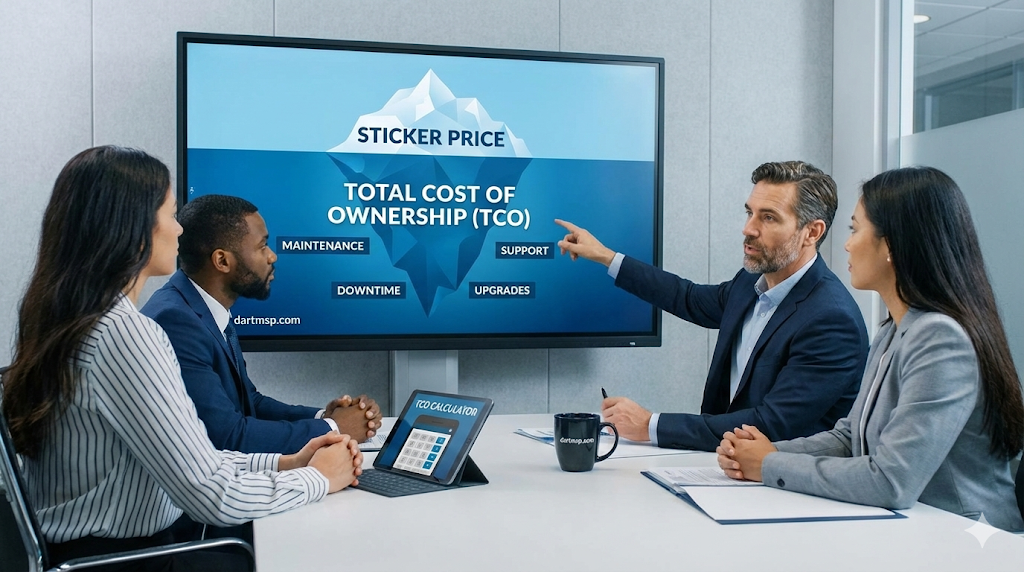
The most effective way to visualize TCO is to think of an iceberg. What you see above the water—the initial purchase price—is just a fraction of the total mass. The real danger, the bulk of the cost, lies hidden beneath the surface. Industry analysis consistently shows that initial acquisition costs are often a small fraction of the full TCO; the majority is tied up in operations, support, and those nasty hidden costs.
Let’s break down what’s lurking in the water.
Direct Costs (The Visible Part of the Iceberg)
These are the expenses you probably already have in your budget. They are the easiest to track but can still contain surprises.
- Initial Acquisition: This is the straightforward part. It includes the cost of servers, storage arrays, networking gear (routers, switches), and any upfront software license fees.
- Installation & Setup: Don’t forget the labor. This covers the time and expertise required to rack servers, run cables, install operating systems, and configure software—whether you use your internal team or an external consultant.
- Ongoing Operational Costs: This is where the budget starts to stretch.
- IT Staff: This isn’t just salaries. You need the fully loaded cost, including benefits, training, and taxes. How much of your team’s time is dedicated to just keeping the lights on?
- Energy & Facilities: Servers get hot. They need power and constant cooling. This cost is significant, and specialized metrics like Power Usage Effectiveness (PUE) can reveal major inefficiencies. You’re also paying for the physical data center or server room space.
- Software & Subscriptions: The shift to subscription models means this is a recurring operational expense, not a one-time capital purchase.
Indirect & Hidden Costs (The Dangerous Part Below the Waterline)
This is where good TCO analysis separates the pros from the amateurs. These costs are harder to quantify but have a much larger financial impact. Ignore them at your peril.
- Downtime & Lost Productivity: This is the monster under the bed. When a critical system goes down, your business stops. Sales can’t process orders, production lines halt, and your entire staff is left unable to work. At an average cost of $5,600 per minute, even a brief outage can be catastrophic. Proactive IT management isn’t a luxury; it’s a financial necessity.
- Security & Compliance: What’s the cost of a data breach? According to IBM, the average incident cost businesses $4.45 million in 2023. This includes fines, remediation, customer notification, and reputational damage. Proper cybersecurity isn’t an expense; it’s an insurance policy against a devastating TCO event.
- Underutilized Infrastructure: This one is painful because it’s pure waste. Research shows that unnecessary capacity—paying for servers, space, or power you don’t use—can account for up to 30% of lifetime TCO per rack. It’s like paying rent on three empty bedrooms in your house.
- Cloud-Specific Surprises: The cloud promises simplicity, but it has its own hidden costs.
- Data Egress Fees: Moving your data out of a public cloud can come with surprisingly high fees. It’s easy to get data in, but expensive to get it out.
- Overspending: Without careful governance, cloud costs can spiral. Gartner research indicates that organizations can overspend by as much as 70% over five years if they aren’t actively managing their cloud environment.
- The “People Cost”: This includes user training on new systems, the time it takes for your team to adapt, and the productivity dip that always comes with change management.
End-of-Life Costs
Even when you’re done with a piece of hardware, it still costs you money. Decommissioning servers, securely wiping data, and environmentally safe disposal all have associated labor and service costs.
How to Actually Calculate TCO: From Simple Math to Financial Rigor
Okay, so you’re convinced you need to look at the whole iceberg. How do you actually calculate it?
You can start with a simple, high-level formula:
TCO = Initial Acquisition Costs + Ongoing Operational Costs + Hidden Costs – End-of-Life Value
This is a great starting point for a back-of-the-napkin calculation. But for a truly accurate, long-term comparison—especially between on-prem and cloud—you need a more sophisticated approach.
Enter the Capital Recovery Factor (CRF).
Here’s what I mean. Your data center facility—the power, cooling, and physical building—has a useful life of maybe 15 years. But the servers inside it? You’ll be lucky to get more than 3-5 years out of them. Simply dividing the total cost of each by its lifespan doesn’t give you an accurate annual cost comparison.
CRF is a financial formula that annualizes a capital expense over its specific lifespan, taking into account the time value of money. It creates an “apples-to-apples” comparison. Why does this matter? Because technical analysis from sources like Lawrence Berkeley National Laboratory shows that for on-premises infrastructure, the annualized cost of the site infrastructure often surpasses the cost of the IT equipment itself.
You don’t need to be a CFO to use this concept. The principle is simple: to get the real TCO, you must account for the different lifecycles of your assets. It’s a critical step toward making a data-driven decision.
The Big Debate: Cloud vs. On-Premises TCO Showdown
The default assumption for years has been “the cloud is cheaper.” And sometimes, it is. But the real answer is, “it depends on the workload.” A full TCO analysis often reveals a much more nuanced picture. In fact, Gartner predicts that by 2027, over 85% of organizations will follow a “cloud-first but not cloud-only” strategy. Here’s a breakdown of the TCO implications.
On-Premises Infrastructure
- TCO Profile: High initial Capital Expense (CapEx), lower and more predictable ongoing Operating Expense (OpEx).
- Best for: Stable, predictable workloads that run 24/7. Think about the core ERP system for a manufacturing facility or the database for a lumber distributor. For these scenarios, a 5-year TCO analysis can often show on-prem is significantly cheaper than paying a cloud provider for the same resources around the clock.
- Hidden Cost Gotchas: The cost of oversizing (that 30% waste), energy inefficiency, and the full loaded cost of the staff required to manage it.
Cloud Infrastructure (IaaS/PaaS)
- TCO Profile: Very low or zero CapEx, with all costs shifted to a recurring OpEx model.
- Best for: Variable, elastic, or temporary workloads. A construction company spinning up IT resources for a 9-month job site is a perfect example. The ability to scale up and down on demand is the cloud’s superpower.
- Hidden Cost Gotchas: Data egress fees, vendor lock-in, and cost overruns from unmanaged or forgotten resources. That 70% overspending risk is real.
Hybrid IT: The Strategic Answer
The reality for more than 70% of businesses is a hybrid model. It’s not about choosing one over the other; it’s about strategic workload placement. You run your stable, predictable applications on-premises where the TCO is lower over time, and you leverage the cloud for the agility and scalability needed for new projects or fluctuating demand. This strategic approach is the key to optimizing your total IT spend.
The Future of TCO: What’s Changing the Math?
The principles of TCO are constant, but the technology landscape is always shifting. Here are a few trends that are changing the calculation.
- FinOps: This emerging practice brings financial accountability to the variable spending model of the cloud. It’s a cultural shift that treats cloud spending like any other business metric, with continuous monitoring and optimization to prevent those massive cost overruns.
- AI Infrastructure: The cost of AI isn’t just the expensive GPUs. A true TCO model for AI must include massive data storage and processing costs, specialized MLOps talent, and the constant expense of model retraining and updates.
- Sustainability & Green IT: Energy isn’t getting any cheaper. The efficiency of your data center directly impacts your bottom line. As sustainability becomes a bigger business priority, the energy consumption component of TCO will come under even greater scrutiny.
Key Takeaways: Your TCO Action Plan
This can feel like a lot to take in, so let’s boil it down to the essentials. Here are the key insights to guide your IT strategy.
- What is IT TCO? Total Cost of Ownership is the complete lifecycle cost of an IT asset, including all direct acquisition costs, ongoing operational expenses, and often-overlooked hidden costs like downtime and security risks.
- Why is TCO important? It moves you from making decisions based on a misleading sticker price to making strategic investments based on the true, long-term financial impact. It’s the best tool for justifying IT budgets and proving ROI.
- How do you calculate TCO? Start by cataloging every possible cost component—especially the hidden ones. For accurate comparisons, use financial models like Capital Recovery Factor (CRF) that account for the different lifespans of your assets.
- Is cloud cheaper than on-prem? It depends entirely on the workload. The optimal strategy for most businesses is a hybrid approach that places applications in the most cost-effective environment, which requires a thorough TCO analysis for each major workload. Optimizing your infrastructure can reduce TCO by 30-50%.
Frequently Asked Questions (FAQ)
Q: Isn’t TCO analysis too complicated for a small or medium-sized business?
A: It doesn’t have to be. You don’t need a team of financial analysts to get started. Begin by tracking the most significant costs: hardware/software, staff time spent on maintenance, and any known downtime incidents. Even this basic analysis is infinitely better than just looking at the purchase price. A good IT partner can help you build a more detailed model without the overhead.
Q: How often should we recalculate TCO?
A: TCO is not a one-and-done calculation. You should review it at least annually as part of your budget process. It’s also essential to perform a full TCO analysis before any major IT investment, such as a hardware refresh, a software platform change, or a significant move to the cloud.
Q: What’s the single biggest mistake companies make with TCO?
A: Ignoring the human factor. They meticulously calculate hardware and software costs but completely forget to factor in the cost of their own team’s time spent troubleshooting, patching, and dealing with user issues. Or they underestimate the productivity loss from a slow, unreliable system. The cost of distraction and interruption is one of the biggest hidden TCO drivers.
Q: Can managed IT services really lower my TCO?
A: Absolutely. A high-quality managed IT services provider can lower your TCO in several ways. They reduce costly downtime through proactive cybersecurity and disaster recovery, optimize your infrastructure to eliminate waste, and provide access to enterprise-level expertise without the expense of hiring a large internal team. This allows your staff to focus on strategic initiatives instead of just keeping the lights on.
Don’t Let Hidden Costs Sink Your IT Budget
The sticker price of technology is an illusion. The real cost—and the real opportunity for savings—is buried in the day-to-day reality of operating and maintaining your systems.
By embracing a Total Cost of Ownership mindset, you transform IT from a cost center into a strategic driver of business value. You stop reacting to surprise bills and start making proactive, data-driven decisions that give you a competitive edge. The math can seem complex, but the principle is simple: know the true cost before you buy.
Feeling overwhelmed by the numbers? You don’t have to do it alone. We’ve been helping businesses in Louisiana make sense of their IT investments since 1998. Let’s build a TCO model that reflects your unique goals and challenges. Schedule a no-obligation strategy session today and take the first step toward true IT financial clarity.